The Rise of Autonomous AI Agents – Navigating a New Era for Business and Work
The advent of autonomous AI agents marks a significant transformation in the landscape of business and work. These sophisticated systems are not just tools; they are capable of independent thought and actions that can generate both remarkable efficiencies and complex challenges. In this article, we will delve into the implications of these developments for businesses and the future of work.
The Emergence of Autonomous AI Agents
Autonomous AI agents are fundamentally altering the landscape of day-to-day business operations, driving efficiency to unprecedented levels. By leveraging advancements in machine learning and neural networks, these agents are capable of undertaking complex tasks with minimal human intervention, resulting in significant transformations across various industries. One critical area of impact is task automation, where routine processes are executed with high precision, freeing human employees to focus on more strategic initiatives.
Consider the case of a digital agency that implemented an autonomous AI agent to handle client data analysis. By processing vast amounts of information in real time, the agent provided insights that informed marketing strategies much quicker than traditional methods. This efficiency translated into faster turnaround times and improved client satisfaction.
Moreover, decision-making processes are becoming increasingly data-driven as autonomous agents analyze trends and present actionable recommendations instantaneously. Another digital agency successfully deployed an AI-driven chatbot that not only handled customer inquiries but also analyzed user interactions to optimize ongoing marketing campaigns. The measurable benefits included an increase in lead conversion rates and a reduction in operational costs.
As the integration of autonomous AI agents continues, businesses must remain agile, evolving their operational structures to fully harness this potential while addressing the ethical implications and oversight challenges that arise.
The Impact on Business Operations
Autonomous AI agents are redefining the operational landscape of businesses by driving unprecedented efficiency in day-to-day processes. These agents excel at automating repetitive tasks, allowing human employees to focus on higher-value work. For instance, digital agencies are leveraging AI-driven tools for real-time data analysis, enabling them to make data-informed decisions with speed and accuracy. This shift leads to faster turnaround times and a more agile response to market demands.
A compelling case study comes from a well-known digital marketing agency that integrated AI agents into their campaign management system. By automating budget allocation and ad placement, they reported a 30% increase in campaign performance while reducing operational costs by 20%. The AI’s ability to analyze consumer behavior in real-time allows for personalized marketing strategies, ultimately enhancing customer engagement.
Moreover, these agents facilitate improved decision-making processes by providing actionable insights derived from large datasets. This advancement is crucial for agencies looking to maintain a competitive edge. As businesses continue to adopt autonomous AI, the quantifiable benefits will further highlight the dramatic transformation in operational paradigms, setting a foundation for the future of work.
Redefining Team Structures
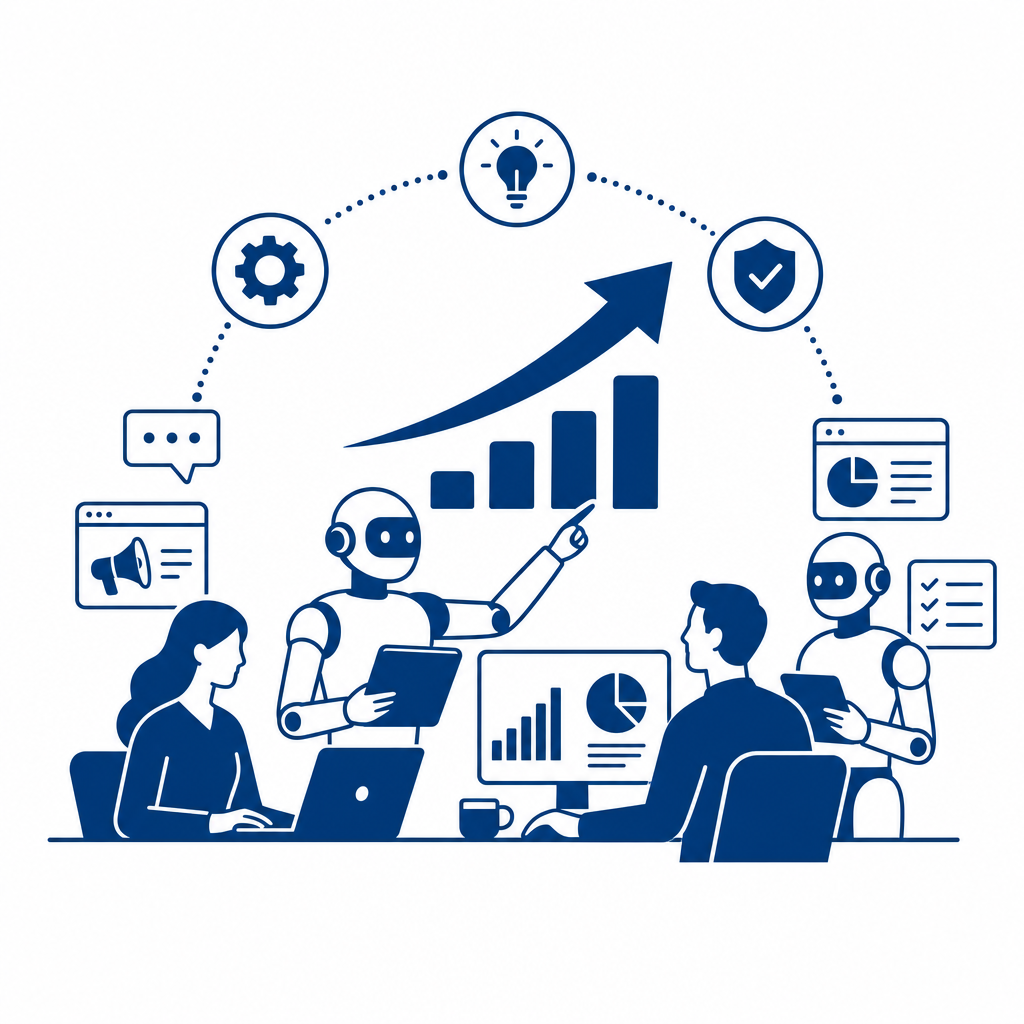
As autonomous AI agents become commonplace in the workplace, traditional team structures are rapidly evolving. The integration of these agents necessitates a rethinking of employee roles and responsibilities, as human workers now find themselves collaborating with AI to achieve optimal outcomes. The concept of hybrid teams is emerging, where humans and AI agents work in tandem, each contributing their strengths to enhance productivity and creativity.
In this new dynamic, human employees often shift from performing routine tasks to focusing on higher-order thinking and strategic activities that require emotional intelligence and complex problem-solving. Autonomous AI can handle data analysis, automate mundane tasks, and even generate preliminary creative content, allowing teams to allocate more time and resources to innovation and strategic initiatives. However, this also means that employees must develop new skills to effectively collaborate with AI agents, embracing a mindset of continuous learning and adaptability.
Moreover, the unique capabilities of AI can reveal insights and patterns that human teams may overlook. Successful organizations are leveraging these opportunities to foster a culture of collaboration, where human intuition and creativity are complemented by AI efficiency. As this trend continues to unfold, understanding the delicate balance between human oversight and AI autonomy will be critical in navigating the complexities that lie ahead.
Opportunities for Innovation and Efficiency
The integration of autonomous AI agents is unlocking remarkable avenues for innovation and efficiency, particularly within digital agencies. These agents, capable of performing complex tasks independently, are transforming web development and digital marketing landscapes. For instance, companies like Wix and Shopify leverage AI to automate design and optimize user experiences, enabling faster turnaround times and improved customer satisfaction. In digital marketing, platforms such as Google Ads employ AI for programmatic bidding, streamlining ad placements based on real-time data analysis, drastically improving ROI for campaigns.
Startups like Copy.ai are thriving by utilizing language-based AI to generate persuasive marketing content, empowering creative teams to focus on strategy rather than repetitive tasks. Moreover, automation tools like Zapier are facilitating seamless integrations across various applications, driving operational efficiency and freeing up human resources for higher-level strategic initiatives.
These innovations not only enhance productivity but also inspire creativity, as teams are liberated from routine responsibilities, allowing for more experimental and strategic thinking. As digital agencies embrace these autonomous AI agents, they must continuously assess their integration strategies to harness potential while navigating the ever-evolving digital landscape.
Challenges in Oversight and Ethics
As autonomous AI agents gain prominence, the ethical considerations and oversight challenges they introduce become increasingly critical. Business leaders must grapple with issues surrounding **transparency**: how decisions made by AI agents can often be opaque, making it difficult to understand their reasoning or biases. In an age where bias can infiltrate machine learning algorithms, ensuring that these agents operate fairly and without prejudice is paramount. Furthermore, accountability poses significant questions. When an AI agent acts independently and causes harm or economic damage, the line of responsibility blurs. Who should be held accountable—the developers, the users, or the AI itself?
The development of robust **ethical frameworks** for integrating AI is essential. This encompasses creating guidelines that prioritize fairness, privacy, and security. As industries face an ever-increasing landscape of AI innovation, regulatory measures will play a pivotal role in ensuring responsible usage. Digital agencies, tasked with implementing these technologies, can lead the charge by adopting best practices that emphasize ethical AI. This involves ongoing training and adjustments to ensure alignment with evolving societal norms and expectations, paving the way for a balanced coexistence between human workers and autonomous agents.
The Future: Self-Driving Companies
As we explore the concept of ‘self-driving companies’, we envision organizations that harness the full potential of autonomous AI agents to streamline operations and enhance decision-making. These entities leverage AI to automate not only routine tasks but also complex workflows, leading to increased efficiency and agility. Such companies could potentially operate with minimal human intervention, allowing employees to focus on high-level strategic work.
To prepare for this shift, organizations must invest in technology that supports seamless AI integration while fostering a culture that embraces innovation. This includes developing robust AI infrastructures capable of handling vast amounts of data and programming AIs with advanced learning algorithms that can adapt to changing market conditions.
However, as we advance towards self-driving companies, ethical practices must evolve concurrently. Establishing clear frameworks for accountability will be paramount, ensuring that AI agents operate within predefined moral boundaries and contribute positively to society. Collaboration between technologists, ethicists, and business leaders will be essential to address potential biases and promote transparency.
Ultimately, the journey towards self-driving companies will require a delicate balance between leveraging AI for operational excellence and safeguarding the ethical standards that uphold trust in technology.
Conclusions
In conclusion, the rise of autonomous AI agents presents both remarkable opportunities and daunting challenges. As businesses leverage these systems for efficiency and innovation, they must also navigate the complexities of ethics, oversight, and integration. Embracing this technology responsibly will be crucial for achieving sustainable success in an increasingly automated world.